Turning toward the light

peonies at dawn

At first light, peonies catch the sun they have grown toward, facing upward like brilliant trumpets. All around creatures adapted to the dark move toward places to hide. For them, dawn is a chaos of territorial warbling. The steady change they craftily evade empties their nightish niche of its mystery, leaving them dull in their gray hollow. They creep and amble for cover. The world has turned.

The earth tilts a little more toward the sun, and the snows melt and the flowers restore themselves. The gardener returns to his rounds, the daily tasks that join his small doings to a vast progress. He leaves the news unread on good days, ignoring the losing battles, the rebels against reality.

Thinking is better than wishing, as the days lengthen and light floods the landscape’s forms and colors. What was hidden or forgotten returns. It’s the season of real work. Meaning is dependent on truth, which resonates like God’s thunder in the distance, behind the pirouetting retreat of the dark ones, moving through a forest they cannot name.

Emerson: nature and words

Hawthorne branches in blossom...

An English Hawthorne in May. The boughs were popular for May Day decorations before the adoption of the Gregorian calendar in 1752, after which the trees did not bloom until mid-May. The ancient Greeks carried hawthorn branches in wedding processions, as emblems of hope.

I intended to start summer by reading Voegelin on Plato. I’m interested in what they both say about the metaxy–the inbetween of the immanent and the transcendent, where we experience being. For young people unfortunate enough to have grown up under the influence of a deconstructive culture which drowns out reality with propaganda, replacing God’s kingdom with their own, their most sacred feelings and emotions are reinterpreted within a bottomless self endlessly chattering amid legions of desires and fears.

I want to think more about today’s language wars, which lie at the heart of modernity’s global contests to replace Creation with Ideology.
I’ve been re-reading Emerson’s “Nature” –or at least listening as I drove the old truck to Missoula for a couple yards of compost. I was surprised at how prescient Emerson was in his discussion of language. He begins his chapter on language with three statements about nature and language:

1. Words are signs of natural facts.
2. Particular natural facts are symbols of particular spiritual facts.
3. Nature is the symbol of spirit.

I read these words when I was in college, but I don’t remember them making any particular impression on me. Today they seem precisely the needed counter to the chorus of antichrists substituting myraid uncertainties for every natural fact. They would destroy such words as male, female, marriage and family by positing endless expanding tangles of meanings, as though the tree of life were a bramble thicket.

Emerson understood nature as language, a way of thinking consistent with Genesis, where God speaks our world. Words refer to realities–to categories that actually exist in Creation, and we can speak truth:

A man’s power to connect his thought with its proper symbol, and so to utter it, depends on the simplicity of his character, that is, upon his love of truth, and his desire to communicate it without loss. The corruption of man is followed by the corruption of language. When simplicity of character and the sovereignty of ideas is broken up by the prevalence of secondary desires, the desire of riches, of pleasure, of power, and of praise, — and duplicity and falsehood take place of simplicity and truth, the power over nature as an interpreter of the will, is in a degree lost; new imagery ceases to be created, and old words are perverted to stand for things which are not; a paper currency is employed, when there is no bullion in the vaults. In due time, the fraud is manifest, and words lose all power to stimulate the understanding or the affections. Hundreds of writers may be found in every long-civilized nation, who for a short time believe, and make others believe, that they see and utter truths, who do not of themselves clothe one thought in its natural garment, but who feed unconsciously on the language created by the primary writers of the country, those, namely, who hold primarily on nature.

It is from nature that we get the images that allow us to think about such things as hope and majesty. Our words are true to the extent that they evoke things as they really are.

Waking to the dawn

Mountains at Dawn

Dawn does not come suddenly; instead, the transformation is vast, steady and sure. Things are changing, so there’s an urgency in the bird songs, borne of both exhilaration and defensiveness. It’s an astonishing cascade of beauty, driven by intense necessity. There’s a peace in it, if peace is understood not as idleness but as endless replenishment. “If we can’t find Heaven, there are always bluejays,” said Robert Bly.

First the robins and then the thrushes, before dawn, with their rich, fluty notes and vibrating trills. The singing is both proclamation and invitation. A lot may depend on the right song, at the right moment. I listen in the early morning dark, participating in the great change that has already begun, and that nothing can slow or turn back.

The “dawn chorus” begins in April, as the neotropicals return, full of mating vigor. It will last until mid-July, when things are more settled. Many male birds sing throughout their breeding season, then are mostly quiet for the rest of the year. In the morning, first the robins and thrushes–large eyes, worm eaters. Second the raspy trills of the wrens, insect eaters. Last the seed eaters, the bell-like tinkling of the finches and the whistling ke-chee of the sparrows.

cedar waxwing

Cedar waxwings’ high, thin shree, a series of single notes, is easily missed in the morning chorus.

The dawn chorus is a complex phenomenon, doing many things, including social signaling about territory and mating. The air is tranquil and sound carries perhaps 20 times as well as at noon. Birds awaken at dawn, before insects are active or there’s enough light to see tiny seeds. The chorus is beautiful, in the ways of this world. It’s a beauty rooted in need–a need to make or keep a relationship or to hold onto a place. Creation is work, awakening.

Armies also awaken at dawn. There’s a terrible beauty in the bugles, the shouted orders, the rustle of getting ready, and the vast assemblage of ranks filled with restless men on the move with things to do, things to hope, things to fear.

Some predators are most active at dawn. These crepuscular hunters include bats, cats–house cats but also ocelots and jaguars–stray dogs, ferrets and rats. Hyenas, bears, skunks, nighthawks and owls are also about, stealthy and opportunistic. A lot is undecided in the early morning, as fresh energy floods the earth, stirring our blood and calling us to the day.

Learning the meaning of nature

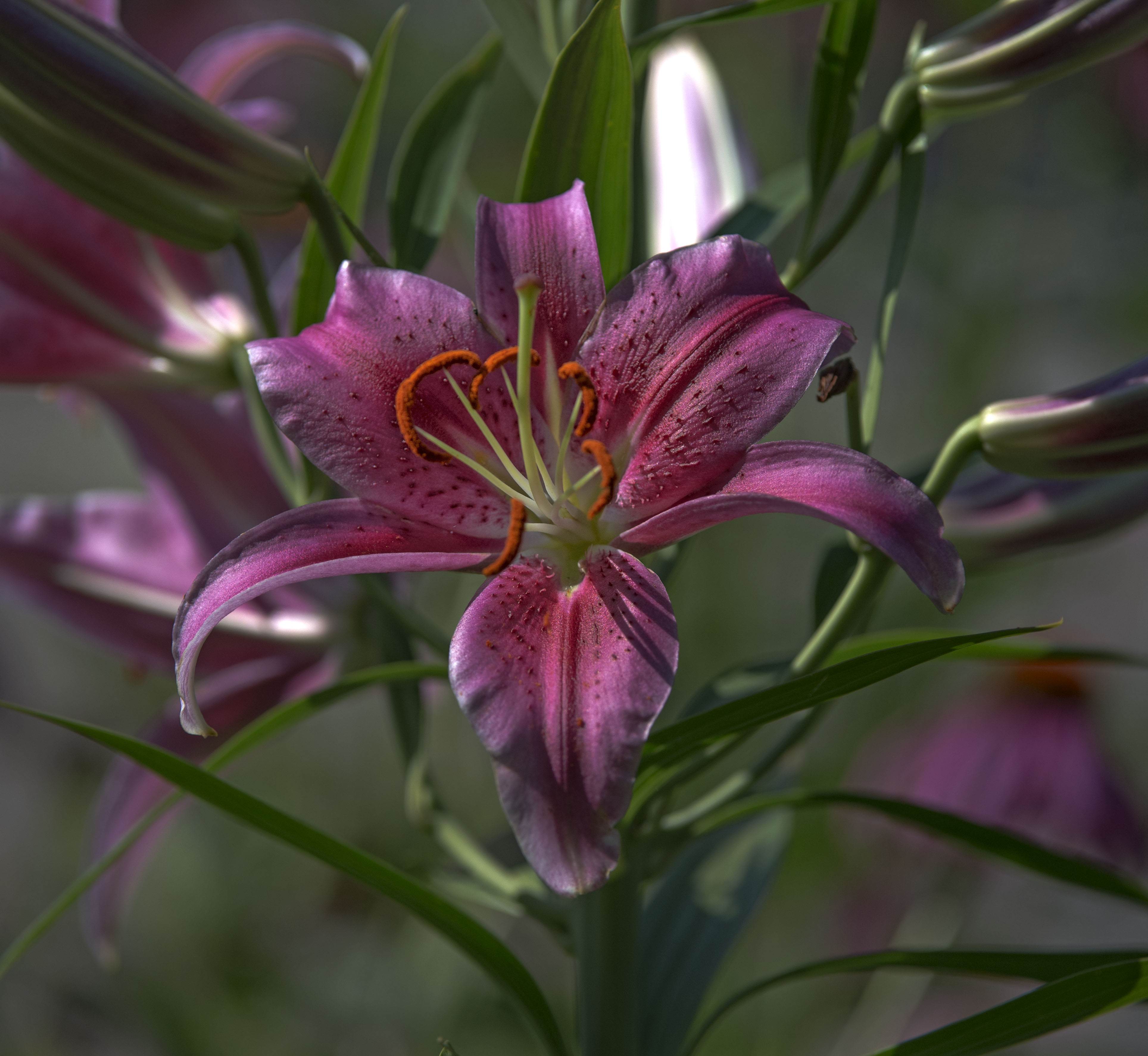
The 'Stargazer' lily does not occur in the wild. Leslie Woodrigg created the upward-facing cultivar in the 1970s, working with hybrids derived in the 1860s from Gold Band lilies and Japanese lilies which had been cultivated for centuries in Japan, China, and Taiwan. Such gardening wonders help us see the meaning of nature.

The ‘Stargazer’ lily does not occur in the wild. Leslie Woodrigg created the upward-facing cultivar in the 1970s, working with hybrids derived in the 1860s from Gold Band lilies and Japanese lilies which had been cultivated for centuries in Japan, China, and Taiwan. Such gardening wonders help us see the meaning of nature.

The leitmotiv of my garden, as I experience it, is that it is the “between” where a gardener encounters the “beyond” from which “all things rise.”

Though everyone recognizes that we live in the world, some people think we think in our minds. But consciousness is not mainly processes in the brain. Watching a young child play for the first time with a bouncing ball, we might observe that as he experiments with force and angle, practicing coordination, his body, the ball, the floor, the wall, and gravity are incorporated into his mind. In practice, we can’t make sense of the ball or the child independently, can’t ‘tell the dancer from the dance,” as Yeats put it. Together they form a single entity, the-boy-and-ball, and the boy is having thoughts that would literally be unthinkable without his body and its senses and a world to engage. His world is the substance of his consciousness.

Similarly, the garden becomes the substance of my mind as I weed and water and watch and smell. To dwell amid gardens is to mingle one’s conscious life with what is given.

Gertrude Jekyll says the garden teaches trust that God will give the increase. Trust is intertwined with the humility that emerges in the presence of things, such as the fragrant symphony of an Oriental lily, that grow from mysteries we cannot fathom.

The gardener does little things—noting the slight wilt of hibiscus leaves and bringing water or seeing a bindweed leaf reach toward sunlight and applying mulch—and wonders ensue—not occasionally but reliably, and in stupendous abundance.

A garden might exemplify the relations of humans to the Beyond—”Th’ Big Good Thing,” as it is described in The Secret Garden by Francis Hodgson Burnett—that “goes on makin’ worlds.”

Stargazer lilies were created by humans deeply reliant on the cooperation of the natural world. Gardens exemplify an intimate co-dependence between people and nature.

The person alone is nothing, able neither to create nor to survive. All we have learned and can do is precarious and dependent on nature, and in this state we learn from the garden an alert waiting, a serene responsiveness, a diligent receptiveness.

And in the process, the gardener helps (in Cézanne’s phrase) to make nature’s meaning clear. Nature is a gift, which teaches us how to care.

Through me the landscape thinks itself

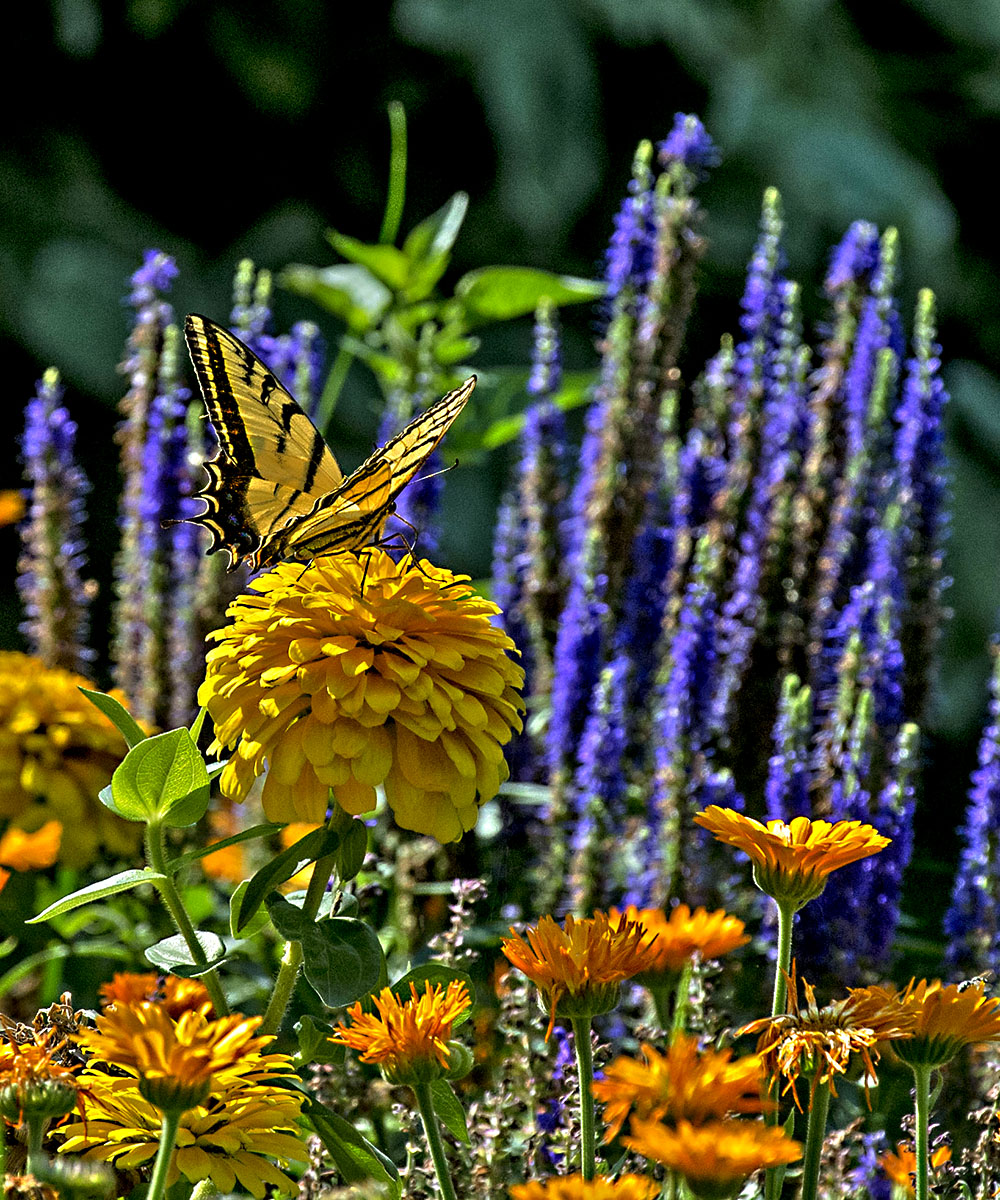
Butterfly on zinnia flower

Canadian Tiger Swallowtail on a yellow zinnia, which is a showy flower rich in nectar—butterflies love zinnias. It’s growing amid a patch of calendula, in front of a stand of blue salvia. The constant work of the pollinators, mainly bees but also some birds and butterflies, is one of the more vivid reminders that a garden is not a “thing” so much as living process. It provides resources for many participants on endless levels.

As I’ve engaged the garden more mindfully, the constant movement of bees, butterflies and hummingbirds drawn to the pollen and nectar has become more vividly present to me, in the course of the slow awakening that is a garden.

At first thought, it’s clear that it is I that am awakening, as what becomes present for me was there before I knew it. But then, I am the garden’s consciousness of what it is—”Through me the landscape thinks itself,” as Cezanne observed. So the garden needs me if it is to awaken to itself.

The garden has less existence without me. I don’t mean my labor, though that is part of it, so much as my awareness of the structured and articulated place I have engaged, without which the garden would be what Nietzsche said the world was without the engagement of a conscious being: “a chaos of sensations.”

So being present to what is present is part of the work—an attentive listening.